Being involved in a collision is stressful enough. Beyond handling insurance claims and auto body repair, you want to ensure your vehicle is restored to a safe, roadworthy condition. Collision repair isn’t about fixing the visible dents and damaged panels. Even a minor crash can compromise wheel alignment, affecting how your vehicle drives. Skipping wheel alignment can lead to uneven tire wear, poor handling, and severe safety risks.
This blog breaks down the core features that make wheel alignment mandatory after a collision repair to ensure safety. Ensuring your vehicle’s wheels are properly aligned is key to safe driving and to preventing costly collision damage down the road.
This guide explains:
What wheel alignment is
How Collisions Affect Alignment
Warning Signs of alignment
Why alignment is a safety issue, problems
Why Alignment Verification Is Part of Proper Collision Repair
Let’s dive in.
What Is Wheel Alignment?
Wheel alignment is the process of setting your vehicle’s suspension angles to help your tires perform precisely while driving. Ideal wheel alignment improves steering, extends tire life, and enhances the performance of safety systems as designed.
Here’s the breakdown:
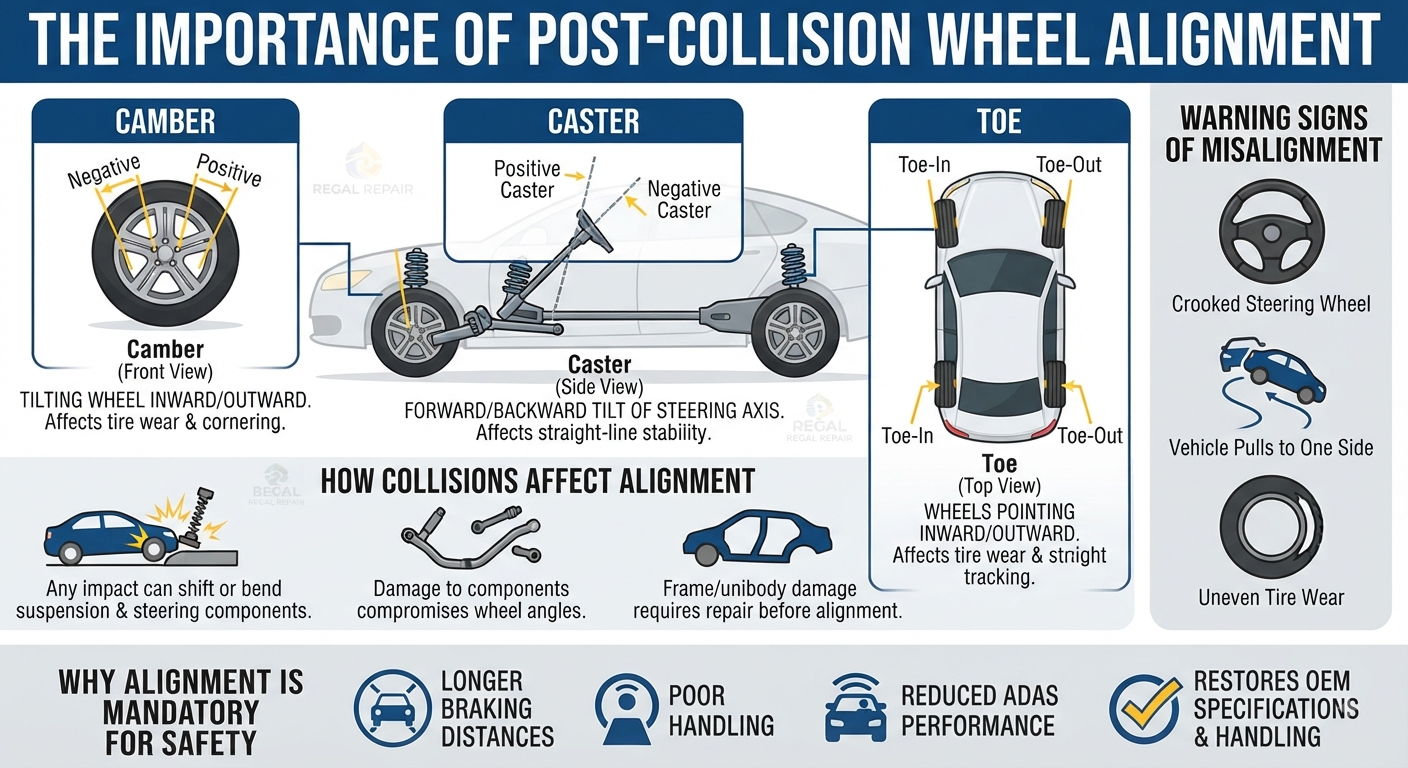
Camber refers to a tire tilting inward or outward when viewed from the front of the vehicle. Excessive negative camber (when the top tire leans inward) or positive camber (the top tire leaning outward) can cause uneven tire wear and poor brake performance (U.S. Department of Transportation, National Highway Traffic Safety Administration (NHTSA)).
The caster shows the forward or backward tilt of the steering axis when viewed from the side. Positive Caster: this improves straight-line stability on the road and helps the steering wheel return to the center after a turn. But if the caster is misaligned or uneven, the vehicle will wander or pull to one side.
Toe demonstrates whether the front edges of the tire point straight inward (toe-in) or outward (toe-out) when viewed from above. Incorrect toe is often the cause of rapid tire wear, reducing tire lifespan by thousands of miles if left uncorrected.
How Collisions Affect Alignment
According to the U.S. Department of Energy, wheel alignment doesn’t just affect steering handling and tire lifespan; it also affects fuel efficiency. When misaligned, your vehicle starts using more fuel than it was designed to.
Any collision can knock a vehicle out of alignment. Impacts spread force through the wheels, suspension, steering components, and occasionally the frame. This changes the angles that keep the vehicle tracking straight.
Curb strikes and wheel impacts can shift or bend the suspension and steering components, affecting the wheel alignment. The tire might look okay after the impact. However, the camber, caster, and toe are often not set correctly, which can cause the vehicle to pull to one side and the steering wheel to go off-center.
Front- or rear-end collisions can damage suspension components, including control arms, tie rods, struts, ball joints, or wheel hubs. These components influence wheel position. Any slight deformation in these areas can lead to rapid tire wear and affect handling stability.
Pothole-like forces happen during many crashes. Colliding with another vehicle, a curb, or any sturdy object can generate an impact load, which is a common cause of wheel misalignment.
Frame or unibody movement is a more serious concern (with frame and unibody). If collision damage shifts the frame, a standard wheel alignment cannot fix the problem. First, the frame needs to be measured and repaired before aligning the wheels.
Driving with poor alignment increases operating costs. According to the U.S. Department of Energy, underinflated or poorly aligned tires increase rolling resistance, deplete fuel faster, and rapidly increase tire wear. Correct alignment maximizes tire life and the vehicle's efficiency.
Warning Signs of Alignment Problems
Wheel alignment often starts gradually rather than suddenly after hitting curbs or potholes or after a collision. Figuring out these signs early can prevent costly tire and suspension repair damage and potential risks.
The vehicle pulls on one side: If your car drifts left or right on a straight, level road without steering it, the wheels are likely out of alignment. And this condition is one of the most common symptoms of misaligned wheels (incorrect camber or toe settings).
Crooked Steering Wheel: When driving, the steering wheel is centered. If your steering wheel is tilted to one side while the vehicle is moving straight, you need an alignment inspection.
Uneven tire wear: A misaligned wheel causes the vehicle's tires to scrub against the road rather than roll evenly, leading to rapid wear on the inner and outer edges of the tires. According to Comtires' field testing, proper wheel alignment can extend tire lifespan by up to 23%.
Reduce fuel economy: Misaligned wheels increase rolling resistance, causing the engine to work harder and draining fuel faster than normal.
Handling instability: Poor vehicle alignment can make steering and handling feel loose, cause the vehicle to wander at highway speeds, or require more effort to position the steering properly. This often poses a high risk and increases fatigue.
Why Alignment Is a Safety Issue
Wheel alignment plays a key part in a vehicle's functionality and safety.
It directly affects how your vehicle brakes, steers, and responds during emergencies. Even small wheel misalignment can pose a significant risk. The common issues:
Longer and less stable braking: A misaligned wheel causes the brakes to take longer to stop due to reduced tire contact with the road, which decreases available traction during braking. Poor alignment always causes the vehicle to pull to one side under intense braking and makes it harder to stop in a straight line.
Slower, Less Predictable Steering Response: When wheel alignment is off, steering becomes less responsive, making the driver work twice as hard to correct the vehicle and keep it centered constantly.
Reduced Control During Emergency Maneuvers: Emergency lane changes, obstacle avoidance, and sudden deviations rely on maximum tire grip with the road. Misalignment reduces the tires' contact patch, lowering stability and increasing the likelihood of skidding or loss of control during critical maneuvers.
Uneven tire wear further compromises safety: Uneven tire wear and reduced traction on wet and slippery roads result from misaligned wheels. This increases the risk of hydroplaning. However, proper four-wheel alignment improves handling, stability, steering accuracy, and braking performance while reducing pulling and preserving suspension components.
Why Alignment Verification Is Part of Proper Collision Repair
Here is why a proper collision repair often includes wheel alignment:
Restore Vehicle (OEM) Specifications: Manufacturers require suspension, steering, and wheel angles to meet precise factory tolerances after repairs. Alignment verification ensures the vehicle tracks, steers, and handles as originally designed.
Confirms structural repairs are completely corrected: It checks that the wheel alignment and suspension meet manufacturer specifications and confirms there is no unresolved structural or suspension damage.
Supports ADAS Performance: Many modern vehicles rely on safety systems, including cameras, radar, and steering angle sensors, to provide features such as lane-keeping assist and automatic emergency braking. ADAS calibration is often required to ensure these systems work accurately.
Serves as a final quality control check: An alignment check verifies that the vehicle drives straight, the steering wheel is centered, and handling is working as designed, meeting the manufacturer's standard before the vehicle is delivered.
Protect Long-Term Safety and Vehicle Value: Wheel alignment verification reduces the risk of rapid tire wear and tear, poor handling, and accelerated suspension damage while helping preserve vehicles' safety, performance, and resale value.
Conclusion
Although the vehicle may look perfect, incorrect wheel alignment can compromise its safety and integrity. This is why professional repair facilities make sure to realign wheels correctly when necessary.
If you notice any signs of wheel misalignment in your vehicle, you can schedule an appointment with Regal Repair to have it fixed.
FAQ
Do I need alignment after a minor accident?
Yes. You need alignment after a minor accident because the wheel and suspension alignments are often off.
How much does alignment cost?
Depending on the level of repair needed, alignment typically costs between $50 and $200.
Can bad alignment damage tires?
Yes. More often than not, bad wheel alignment is the core cause of rapid tire wear and tear.
How long does alignment take?
In a normal situation, 30–60 minutes.
Will insurance cover alignment?
Yes. Most auto insurance coverage includes alignment repair.
Save even more at Regal Repair for all your collision repair needs. Take advantage of our special collision repair coupons and deals to get your vehicle back in shape without overspending. Whether it's a minor dent or major damage, our offers provide affordable, high-quality repair solutions. Don't miss out on these limited-time discounts — explore our deals today and ensure your car receives the best care at the best price! Please mention the website coupon at the time of the vehicle estimate.
Repair Your Vehicle At Regal And Get:
$500
Repair Your Vehicle At Regal And Get:
Min. $2,000 repair job. Coupon may not used toward any other special services.
Before Returning Your Leased Car To The Dealer, Get:
FREE
Lease Return Repair Inspection
Can be combined
Make It Easy With A:
FREE
Car Loaner or Rental
Up to $40 or rental car cost, with min. repair cost of $2000.
Not valid with other services or promotions. For contact info only. Additional exclusions may apply. Offers not for merchant purposes at time of estimate. Must have printouts.




.svg)



.webp)
.png)
.webp)
.avif)
.webp)