

.svg)
Primary location
North Hollywood, LA
-
5430 Cahuenga Blvd,
North Hollywood, CA 91601 - (818) 505-1442
You must have seen cars with uneven paint blends and finishes. No car owner loves seeing color mismatches on their vehicles, because it makes them look like a joke. Perfect paint finishes are both a science and an art.
Using professional auto paint-matching procedures not only makes your car look fresh and flawless but also enhances its market value and safety, and helps prevent costly repairs. Let's break down how seamless factory finishes are achieved.
Paint matching is the process of precisely formulating, adjusting, and applying a refinish paint on a damaged surface (Vehicle) so that repaired areas blend seamlessly with the surrounding areas.
Paint matching is quite a technical process, often required when your car paint is fading, or a particular area has been damaged and needs touch-up. Professional paint matching ensures no visible mismatch - using Delta E to determine accuracy, regardless of factory variations.
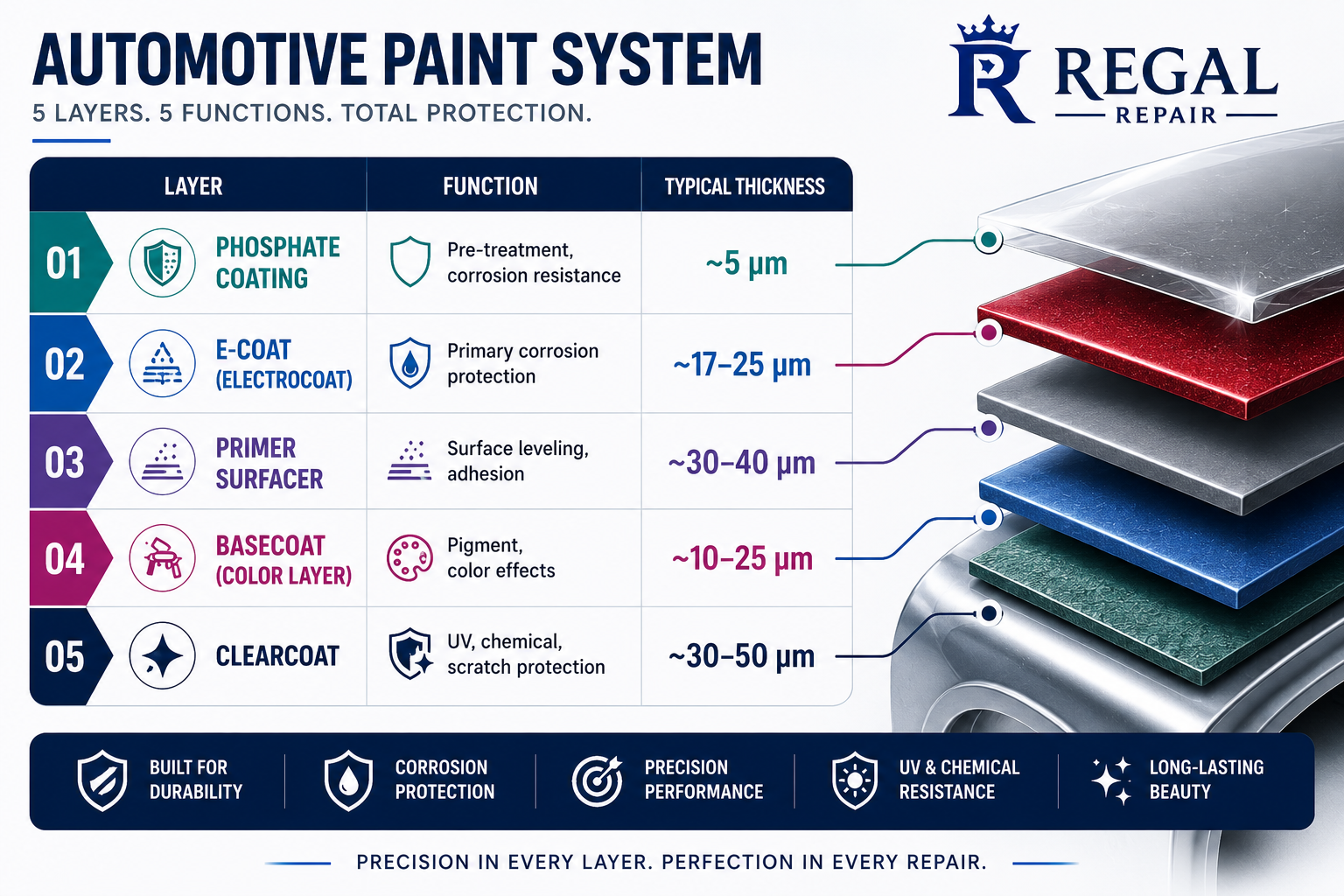
Every Vehicle's paint is engineered to protect it from corrosion and enhance aesthetics and durability. It's not a single layer of paint; it comprises 4-6 layers. These layers have specific thickness measurements and defined functions. For instance, primer, one of the paint layers, provides primary corrosion resistance.
Pre-treatment & E-coat: Pre-treatment and E-coat are applied to the Vehicle's panel via electromechanical processes to ensure the primer chemically bonds to the metal. It also provides a uniform corrosion barrier.
The primer layer is an essential foundation that ensures adhesion between the metal and the paint. It may appear with some smooth imperfections, but it will blend well later.
The base coat reveals the optical properties, including color, metallic, and pearlescent effects. The clear coat is the most critical and thickest layer, protecting your car against chemicals, ultraviolet radiation, and scratches.
The paint-matching process is both a science and an art. It's a science because a computerized color-matching system contains over 10,000 paint-matching formulas.
A spectrophotometer helps you identify the precise formula needed for achieving success. It's an art because it only takes evaluated experience and skills to manage the whole process.
The process of every successful paint match starts with objective measurements. A spectrophotometer captures color reflections from multiple angles. (e.g., 15°, 45°, 75°, 110°).
A spectrophotometer ensures that the digital color fingerprint of the existing Vehicle's paint is captured. Ultimately, certified auto technicians achieve >90% match success with the spectrophotometer.
A computerized color-matching algorithm will scan the existing paint color and process it through a software system that has thousands of paint variants from manufacturer databases to produce an accurate, same-factory paint code.
Spectrophotometer + formula software gets the match right 95% of the time before human adjustment.
The paint code has been identified; now let's mix. For optimal results, mixing is done using a scale rather than volume estimates.
Every step is measured by weight, making it repeatable and helping minimize human error. But technicians still work to microadjust and refine the hue, value (light/dark), and chroma (intensity).
Before painting the Vehicle, technicians test the paint on other panels or spray-out cards to evaluate results under controlled lighting conditions. This helps trained technicians detect errors early and adjust them before the real deal begins.
The car body surface at this point will be thoroughly prepared, as its condition influences the final tone. The surface preparation involves systematic E-coating and priming.
Now, let's talk about the environment. The temperature and humidity of the painting environment affect the color appearance and curing. This is why the environment must be clean, well-lit, and climate-controlled (ideally 70–75°F or 21–24°C).
Here's the list of the most important tools for excellent car paint matching.
Modern paint matching requires a spectrophotometer to capture the light reflection from a vehicle's paint from every angle to achieve an exact match. It simply captures and measures car paint color beyond what human vision can detect. This helps reduce rework up to 30%–50%.
In simple English, a software color database is a technology that stores over 10,000 paint codes from auto manufacturers, organized by date. So, the vehicle's color is extracted and matched against tens of thousands of OEM color variants. More often than not, the results narrow down to the top 3–5 closest matches instantly.
Pryout cards are standardized cards used for surface testing. How well is the paint mixture? Has it achieved an indistinguishable match? The payout car reveals everything when the mixed paint is sprayed on it.
Lighting is highly essential in the paint-matching process. The wrong lighting can make a perfect paint job look wrong. So, here's what modern technicians do. They use daylight-stimulating booths (D65 lighting). A lighting system helps stimulate natural light and eliminate every distortion.
Professional paint matching offers several benefits. Let's cut to the chase.
Amateur paint matching doesn't follow standard procedures. Hence, these visible inconsistencies can reduce a vehicle's value by 10–25% compared to professional paint-matching jobs.
Advanced paint-matching processes leverage high-end tools such as spectrophotometers and computerized color-matching systems to achieve color accuracy.
These devices can capture color details that the human eye cannot detect.
Make the repaired area indistinguishable from the rest of the car body.
Even minor color variations can be easily noticeable under the sun or in good lighting. Professional color matching ensures the color in the repaired spot blends seamlessly and is virtually invisible.
While amateur paint matching tends to fade in a couple of months, experts' finishes last longer.
This is because they ensure the proper application of primer, color coat, and clear coat. Following strict standard guidelines. These layers prevent premature peeling and fading.
When done poorly, paint matching can make you frequent the repair shop for a series of redos—causing delays. Professional paint matching prevents poor results and helps protect your wallet. And yes, it is not just better; it's faster.
Car owners often face the dilemma of choosing between DIY and professional car paint matching.
The truth is, either option is excellent. But one is better than the other.
Here's the breakdown.
Professional paint matching uses advanced equipment, such as proper lighting, spectrophotometers, and computerized paint-mixing systems, to identify, measure, and mix to a fingerprint paint match.
Most DIYs are limited in the standard equipment they have. Such limitations actually affect the paint in the long run.
Professionals have a wealth of experience understanding the surface type, lighting, paint, and other key nuances that ensure a successful paint match. Most DIY paint matching is horrible because it's done with little or no experience. Nonprofessionals rush to touch up the affected areas. No layers or proper paint matching involved.
While DIY is cheaper, it's also slower compared to the time it takes professionals to complete paint matching. The DIY paint-matching process is slower, largely because there is no dedicated facility for the procedure.
Professional paint jobs last 10–15 years longer than DIY applications. This is why you could spot a car with a variable color. The painted spot begins to differ from the surrounding spit visually. In summary, DIY paint matching is inexpensive, but it is only useful for minor fixes. But for severe cases and perfection-driven color matching, it's best to let professionals handle it.
Tips for Maintaining Your Vehicle's Paint After Repair. Most people miss this step. And it ends up affecting the success of their car paint matching.
After painting your car, it needs to dry and cure properly. This typically takes 30–60 days, depending on the environment's temperature and humidity. Paint will be vulnerable if you don't allow it to cure through the curing period. One way to damage your car's paint during its curing period is to wax it. Don't wax your vehicle for 60-90 days to avoid causing defects.
Fresh car paint is chemically sensitive. Substances like oil, fuel, washer fluid, and other chemicals can damage uncured paint surfaces. Ensure the vehicle is packed in a contaminant-free space for curing.
The environment, your store, and your vehicle, both during and after painting, have a significant impact. Studies show that top surfaces (hoods, roofs) degrade faster due to UV exposure. Bad weather or climate conditions have severe impacts on paint health. You will need to park in shaded and covered areas. Avoid too much exposure in the first few weeks.
Don't use an abrasive washing aid on the paint surface, or it will mar the paint. Use microfiber cloths instead because they're soft and effective.
Protection for your car paint includes wax, sealant, or a ceramic coating. Protective coatings improve scratch resistance, maintain shine, and increase durability.
Auto paint matching is a technical process for matching paint colors. But with the right equipment, expertise, and environment, you can achieve up to 99% of the original manufacturer's color match. And the repaired area will look indistinguishable from the rest of the car body.
P.S. If your car's paint is fading, peeling, or showing other issues, we can help at Regal Repair. Contact us here to take a look.
Professional paint matching delivers standardized results through high-end technological equipment, expertise, and specialized facilities that are rarely accessible to touch-up kit users.
Not really. But professional paint matching can achieve near-perfect (99%) results by leveraging paint-matching software such as spectrophotometers, computerized color mixing, controlled lighting, and human microadjustments.
Professional paint matching takes 1–7 days, depending on the severity of damage. For instance, a quick touch-up takes less than 24 hours but is delayed by 1–2 days for curing.
Yes. Paint matching greatly affects a car's resale value. A visual paint mismatch can reduce car resale value by 10–30%
No. While DIY paint matching can achieve a near-perfect match with the right kits, it is not equipped enough to achieve a 100% factory finish.
Metallic or pearlescent paints are complex.
• Professionals ensure proper panel and booth preparation that is free from contamination.
• Have the surface and both ready; metallic particles are dispersed uniformly before spraying to avoid striping.
• Metallic or pearlescent painting is a multi-layered stack. Substrate, primer, basecoat, midcoat, and clear coat. Professionals ensure no letter is missed or executed poorly, as this can affect the final result.
• The spraying process is controlled through a cross-coating pattern. Maintaining consistent gun speed. If a particular area isn't well spread, professionals go over it again.
• They also ensure they follow the spray timing in alignment with the controlled temperature and humidity.
Save even more at Regal Repair for all your collision repair needs. Take advantage of our special collision repair coupons and deals to get your vehicle back in shape without overspending. Whether it's a minor dent or major damage, our offers provide affordable, high-quality repair solutions. Don't miss out on these limited-time discounts — explore our deals today and ensure your car receives the best care at the best price! Please mention the website coupon at the time of the vehicle estimate.


.webp)
.png)
.webp)
.avif)
.webp)