

.svg)

Primary location
North Hollywood, LA
-
5430 Cahuenga Blvd,
North Hollywood, CA 91601 - (818) 505-1442
Some vehicle owners panic when a dashboard warning light suddenly comes on. In reality, it’s not something to be overly worried about. Each light tells you something specific. And you can leverage it to maintain your vehicle’s safety, prevent expensive mechanical failures, and avoid avoidable liabilities. in this blog, we explain, in simple terms and in detail, what the most common Toyota lights mean and when to act.
Let’s get down to business.
Toyota dashboard warning lights are part of the vehicle’s safety system. They communicate the status of systems such as the engine, brakes, airbags, ABS, tire pressure, charging system, coolant, and temperature through icons, colors, and sometimes warning buzzers or messages. This alerts the driver that a defect or malfunction requiring attention has been detected.
🔴 Red = Immediate Attention: Red means urgent action or that the vehicle must stop. For example:
🟡 Yellow/Amber = Warning or Attention Required: Yellow generally doesn’t mean take action immediately, but it communicates the need to pay attention. For instance:
You might want to ask, "What about Green and Blue?"
Not every dashboard light is a warning. Green and blue indicators generally mean the feature or system is operating properly and activated.
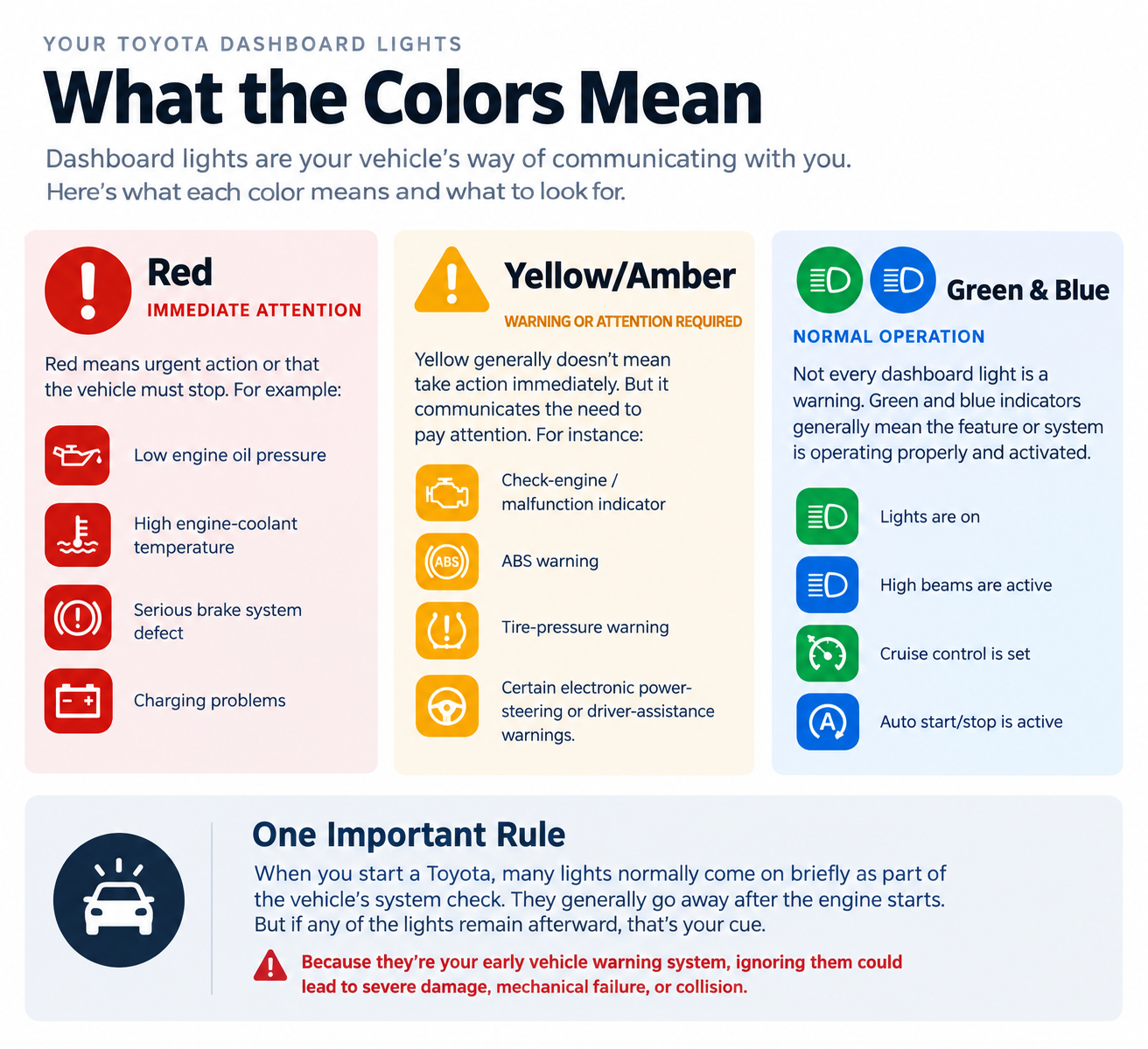
When you start a Toyota, many lights normally come on briefly as part of the vehicle’s system check. They generally go away after the engine starts. But if any of the lights remain afterward, that’s your cue.
Because they’re your early vehicle warning system, ignoring them could lead to severe damage, mechanical failure, or collision.
In February 2026, AAA Club Alliance reported that more than half of vehicle breakdowns are preceded by multiple warning signs. 40% of vehicles on the road have at least one dashboard warning light on.
For instance, some warning lights can indicate systems that protect you during a crash or emergency stop:
A warning light often appears before the problem becomes severe. AAA notes that a check engine warning can indicate anything from a loose gas cap to issues with spark plugs, oxygen sensors, or the catalytic converter.
This dashboard light helps the vehicle regain stability and alignment by controlling engine power and individual wheel braking when the vehicle begins to lose control.
When this light comes on, it indicates an issue with the anti-lock braking system, and the wheel might eventually lock up when the driver steps hard on the brakes.
Tip: Don't ignore a persistent ABS warning light. Take your Toyota to a trusted auto repair facility for inspection.
The traction light indicates your vehicle system is actively managing the wheel grip. Perhaps you're off the paved road, it's raining, or there is dirt on the wheel.
Any of these situations can cause the traction light to come on as an indication, not necessarily a warning. But if it remains on by default for an extended period, it indicates a malfunction that requires urgent inspection.
This light indicates either low tire pressure or a fault in the tire pressure monitoring system. You may need to check or inflate your tires as soon as possible.
The maintenance light indicates that maintenance is due based on mileage. It hasn't really failed, but it's time to check to prevent potential failures.
For example, Toyota’s 2024 Tacoma “Maintenance Required Soon” warning light can appear approximately 4,500 miles (7,200 km) after the reminder is reset.
You will need to reset your "maintenance required" light so Toyota can instruct you when to do it next. And doing that is a piece of cake, provided you follow the right guide. Here's how:
Some older models use a manual reset sequence—not an on-screen menu like newer models. Here's how to go about it:
Caveat: Only reset it yourself after scheduled maintenance is complete. If there are underlying, unaddressed maintenance issues, they need to be sorted out; otherwise, resetting maintenance is just a waste of time.
At the beginning of this blog post, the significance and essence of various dashboard warning lights are explained. That yellow amber light indicates a fault that needs attention, while the red light indicates a fault that requires immediate attention.
The red brake warning light means you should stop. Say you're in the middle of the road; pull over and stop when safe because continuing to drive can be dangerous and suicidal.
Other warning lights, including yellow, generally warn of the following:
And you do not necessarily have to stop immediately. While they're important faults to address as soon as possible, they're not urgent.
This combination calls for special attention.
If the ABS warning light and the red brake system warning light come on together or remain on, Toyota warns drivers to stop the vehicle immediately, as the vehicle's functionality, stability, and safety may be severely compromised.
Call your auto repair shop for professional inspection, diagnosis, and fixes.
An ABS + VSC/TRAC issue doesn't necessarily mean your brake has failed, but it should not be ignored, as a brake defect is involved in the system's detection.
When the light comes on, the key attitude is to neither panic nor ignore the light. Start by identifying the color of the light or symbol, if any, that accompanies warnings.
Subsequently, do take the following actions:
If the TPMS light comes on, carefully check that the tire pressure matches the pressure listed on the driver-side door placard or in the owner's manual. If it's not right, get it inflated right as soon as possible.
Pay more attention to combined warning lights. A combination of steady warning lights is serious. Toyota's warning indicates that when the ABS and brake system warning lights remain on together, the driver should park safely immediately and call Toyota.
If you’re not in the right location to call Toyota, call a professional auto repair facility for help.
Understanding what each dashboard light and symbol represents reduces confusion and helps you make the right decision for your Toyota's safety.
In cases where you need a professional diagnosis and inspection, you can trust Regal Repair to restore your Toyota to normal.
The vehicle stability control light indicates that the system is coordinating engine power and individual wheels to restore the vehicle's stability when it's losing control.
VSC is Vehicle Stability Control, while ABS is Anti-lock Braking System, which protects the wheels from locking up during hard braking.
You can consult your Toyota user manual or follow the steps available in this blog.
The tire pressure monitoring system light indicates a tire pressure issue or a system defect.
es. But if the light remains illuminated after a while, you need to have professionals diagnose and inspect it for potential defects.
Save even more at Regal Repair for all your collision repair needs. Take advantage of our special collision repair coupons and deals to get your vehicle back in shape without overspending. Whether it's a minor dent or major damage, our offers provide affordable, high-quality repair solutions. Don't miss out on these limited-time discounts — explore our deals today and ensure your car receives the best care at the best price! Please mention the website coupon at the time of the vehicle estimate.


.webp)
.png)
.webp)
.avif)
.webp)