

.svg)

Primary location
North Hollywood, LA
-
5430 Cahuenga Blvd,
North Hollywood, CA 91601 - (818) 505-1442
Not every replacement part installed on your vehicle is the same. While some parts meet OEM (original equipment manufacturer) standards, others may differ and can lead to poor fitment, lost resale value, safety risks, and forfeiture of insurance claims.
In this guide, we will break down the key differences between OEM and aftermarket parts, explain when each makes sense, and help you make informed decisions the next time your car needs a part replacement.
So, fasten your seat belts; let’s get started.
When a component on your vehicle is damaged beyond repair, you will typically have two replacement part options: OEM (Original Equipment Manufacturer) parts or aftermarket parts. Understanding the difference helps you make quality safety decisions and long-term value decisions.
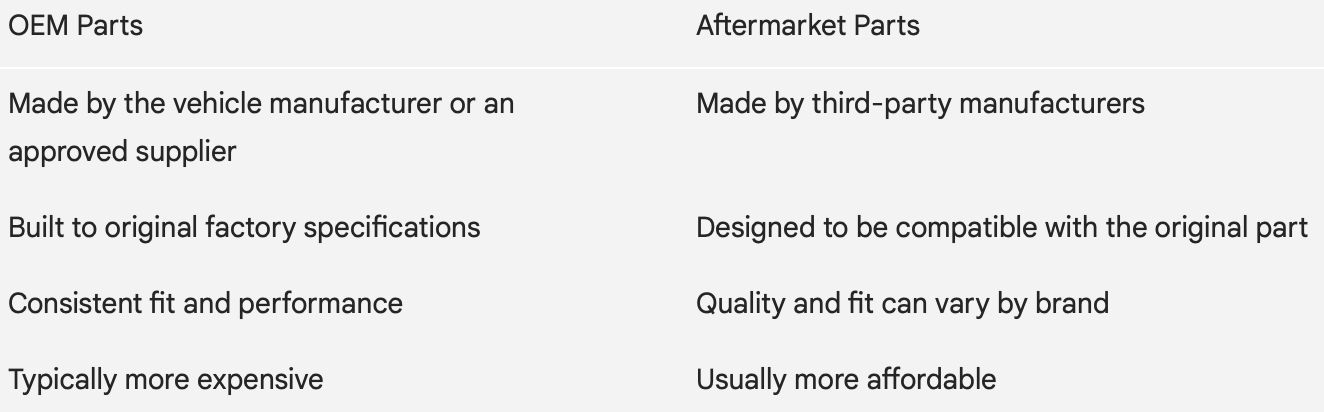
OEM parts are the original parts made by the same company (or its approved supplier) that built the vehicle. They are manufactured to match original factory specifications, providing the same fitment, function, and performance as the part installed when the vehicle was new.
Aftermarket parts. They’re produced by independent manufacturers rather than the vehicle’s original manufacturer. They’re designed to fit multiple vehicle makes and models and are sold at lower cost. However, fitment, quality, and materials across original brands can vary significantly.
Modern vehicles rely on precise engineering for efficiency and safety. Small shifts in repair or replacement can affect crash performance, driver assistance systems, and occupants' protection. Here’s the complete explanation.
Front and rear crumple zones are designed to absorb crash energy during a collision and reduce the force transmitted to the vehicle's occupants.
Today, vehicles are designed to contain dozens of electronic control units (ECUs) and numerous sensors that support advanced driver assistance systems such as lane-keeping assist, blind-spot monitoring, and adaptive cruise control. Minor changes in bumper installation can affect performance. This often requires recalibration after repair.
Improper replacement of high-strength steel, ultra-high-strength steel, aluminum, and composite materials that are strategically used for occupant safety and vehicle integrity can reduce crash-force efficiency. And this is one of the biggest safety concerns when it comes to part replacement.
We’ve worked on hundreds of vehicles at Regal Repair, and one thing is constant: the precision in the manufacturer's part engineering. They specify repair tolerances measured in millimeters.
So, misaligned structural components can easily affect suspension geometry, airbag deployment timing, and ADAS sensor accuracy even when the vehicle appears repaired on the outside.
While there are arguably some high-quality aftermarket parts. IIHS has researched aftermarket parts for more than 30 years and concluded that some certified aftermarket parts can perform as well as OEM parts when they meet original engineering specifications. But other aftermarket parts are lower-quality and can compromise vehicle safety, reliability, and repair quality.
Below are the real-time issues.
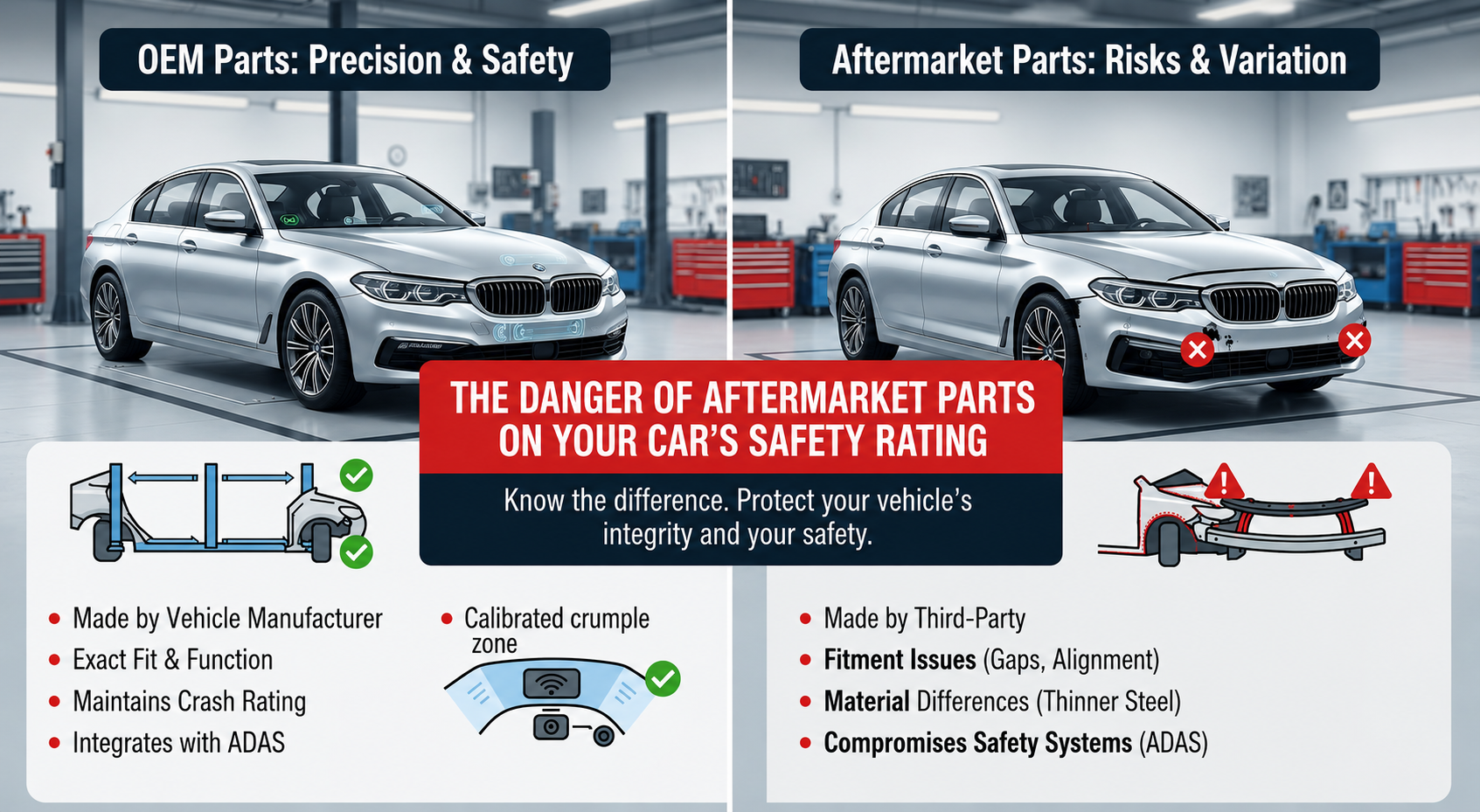
Lower-quality aftermarket parts are more likely to have inconsistent measurements and manufacturing tolerances that lead to water leaks, poor gaps, and poor alignment. They also take longer to repair. However, certified aftermarket parts can fit significantly better than non-certified alternatives (2010 CAPA study).
Some low-grade aftermarket parts use thinner steel, poor plastic, or weaker composites than OEM parts. Over time, these material differences reduce quality, durability, and structural integrity.
We can use some non-certified aftermarket bumpers as a case study. When placed, they are either too thick to allow ADAS sensors (cameras, radar, and ultrasonic sensors) to function as designed or too out of place to mount correctly. And this situation poses significant safety risks if left unaddressed.
OEM parts ideally undergo rigorous engineering and crash-performance testing to integrate with a vehicle's original crash-management system. So that they can perform well in crash situations. But lower-quality aftermarket structural components may not absorb or distribute crash forces the same way, potentially putting occupants at risk in a subsequent collision.
There are apparently some unsafe aftermarket parts. But in many cases, high-quality aftermarket components serve for nonstructural, cosmetic, or maintenance-related repairs when they meet industry standards and don’t affect the vehicle's safety systems or crash performance. Some typical situations when aftermarket parts may be acceptable include the following:
Components such as grilles, mirror caps, trim pieces, emblems, and splash guards may be acceptable if their fit and finish meet OEM standards. They generally don’t contribute to a vehicle's structural crash protection.
Aftermarket replacements generally use filters, windshield wipers, floor mats, batteries, and some brake components from reputable manufacturers.
According to the Auto Care Association, the U.S. aftermarket industry supplies replacement parts for routine maintenance for over 290 million vehicles on the road, making it a well-established segment of vehicle ownership (Auto Care Association, 2025 Facebook).
For aging vehicles whose OEM parts are almost out of the market, difficult to source, or cost-prohibitive, quality aftermarket parts can provide effective solutions without compromising reliability if they’re installed correctly.
Never use aftermarket parts for critical safety structures without manufacturer approval." type="warning">Structural components (frame rails, crumple zones, and reinforcement bars), airbag components, and advanced driver assistance systems (ADAS) components should only be replaced with OEM parts because they’re delicate and critical components that directly influence crash performance and determine occupant protection.
They should be used only in such situations if approved by manufacturers. Otherwise, it's fundamentally unacceptable.
Before approving repairs, ask these questions to ensure you’re getting safe, high-quality replacement parts:
You need to know what type of part the repair shop is about to install into your car. OEM (Original Equipment Manufacturer) parts are made to vehicle manufacturers' specifications, whereas aftermarket parts may differ in quality. Asking ahead helps you understand what you’re paying for.
U.S. insurers often allow aftermarket parts in collision repairs, but they’re not always identical to OEM components.
Understanding who (name) manufactured the part that is about to be installed on your vehicle helps you easily assess its quality. Especially for aftermarket parts, ask for the manufacturer's name and whether it’s CAPA-certified or meets equivalent quality standards.
Modern vehicles rely on sensors, cameras, and radar integration into the bumpers, windshields, and body panels. Some replacement parts do not help them function properly, putting vehicles and occupants at severe disadvantages and risks on the road. This is why the replacement part must facilitate the Advanced Driver Assistance Systems (ADAS) functionality.
According to I-CAR, repairs involving bumper, windshield, and body panel replacement often include calibration of sensors, radar, and cameras to restore proper system performance.
Replacement parts are essential to the safety and value of a vehicle.
If any auto repair facility cannot guarantee the quality of a replacement part by offering a warranty, that’s a message. The replacement part is low-quality and high-risk. You should look somewhere else already.
Aftermarket parts vary in quality, and that can be problematic, especially when critical safety-related components are involved. This calls for careful consideration. Understanding and ensuring the right part replacements for your car protect both safety and resale value.
You can also ask Regal Repair for help in matters of parts replacements or recommendations when you’re not sure. We’re always happy to help you out.
Yes. While aftermarket parts are not always as reliable as OEM parts, CAPA-certified parts are considered safe.
No. Whether you’re using OEM or aftermarket parts, the replacement that meets your needs is what you will ask for. Your insurer can only recommend. Not enforce.
Yes. In many recorded cases in the auto industry, OEM parts are worth much more than aftermarket parts in the auto resale market.
OEM (original equipment manufacturer) parts are precisely the best fit according to the manufacturer's standards, while aftermarket parts are not always identical to the manufacturer's recommended parts.
When auto repair replacement involves critical parts such as structural components (frame rails and crumple zones) and ADAS safety systems, use OEM.
Save even more at Regal Repair for all your collision repair needs. Take advantage of our special collision repair coupons and deals to get your vehicle back in shape without overspending. Whether it's a minor dent or major damage, our offers provide affordable, high-quality repair solutions. Don't miss out on these limited-time discounts — explore our deals today and ensure your car receives the best care at the best price! Please mention the website coupon at the time of the vehicle estimate.


.webp)
.png)
.webp)
.avif)
.webp)