
Your car could end up with a dent from a stray ball, a shopping cart, a neighboring car door, or an everyday mishap. While these dents can look minor, leaving them unrepaired can lead to bigger issues over time—including paint damage, corrosion, and reduced resale value. You've got two options to fix the damage: mobile dent repair or body shop repair. Although both options are excellent, they differ significantly in cost, turnaround time, repair method, and the type of damage they can effectively fix. Choosing the wrong option could mean spending more money and getting less-than-ideal results.
This article explains when each option is best and what drivers often don’t learn until later. Let’s get right into it.
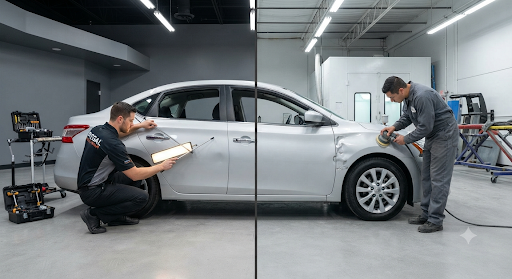
Mobile dent repair is a specialized service that sends trained technicians to your home, workplace, or another convenient location to repair minor vehicle dents, eliminating the need to visit a repair shop. In this situation, you enjoy utmost convenience. This service is commonly effective for small dents, door dings, and hail damage, especially when the vehicle’s paint remains intact. The technician uses Paintless Dent Repair (PDR). This method carefully massages the metal back into its original shape without sanding, body filler, or repainting. Paintless Dent Repair can often restore minor damage in about an hour for a single dent, while hail damage typically takes 1–3 days, depending on severity.
According to industry experience, 80–90% of minor dents qualify for paintless dent repair. And this is why mobile dent repair is a practical option for many everyday parking lot dents and weather-related damage.
No repainting is required; repairs are typically completed much faster than traditional bodywork while maintaining the vehicle’s original factory condition.
Mobile paintless dent repair is a flexible method that requires trained technicians to travel to the customer's office, home, or other location to repair dents. The mobile dent repair procedure is simple:
The mobile service offers the same repairs as the body shop, but they're only performed at the customer's location or home with the full equipment necessary.
It works best when the paint remains intact, and the metal hasn’t been excessively scratched. Commonly used for:
Important Note: Not all dents qualify for PDR. Deep dents, sharp creases, cracked or chipped paint, severely scratched metal, or damage in inaccessible areas often require conventional (traditional) body repair and repainting instead.
Mobile auto repair is most effective when damage is minor and qualifies for paintless dent repair. That doesn’t mean the service is convenient. The condition, size, and location of the dent determine whether mobile repair is the right solution.
Mobile repair effectively works for the following:
Some minor dents in sensitive or sharp angles are often inaccessible when trying to massage them from behind. This is why location matters. Only dents at accessible angles are typically considered for mobile dent repair.
Mobile paintless dent repair is not the best fit option in some cases. It’s only excellent for minor repair. Trying to repair severely damaged vehicles with mobile paintless dent repair can compromise a vehicle's appearance and safety.
Typical situations where PDR is not the right option:
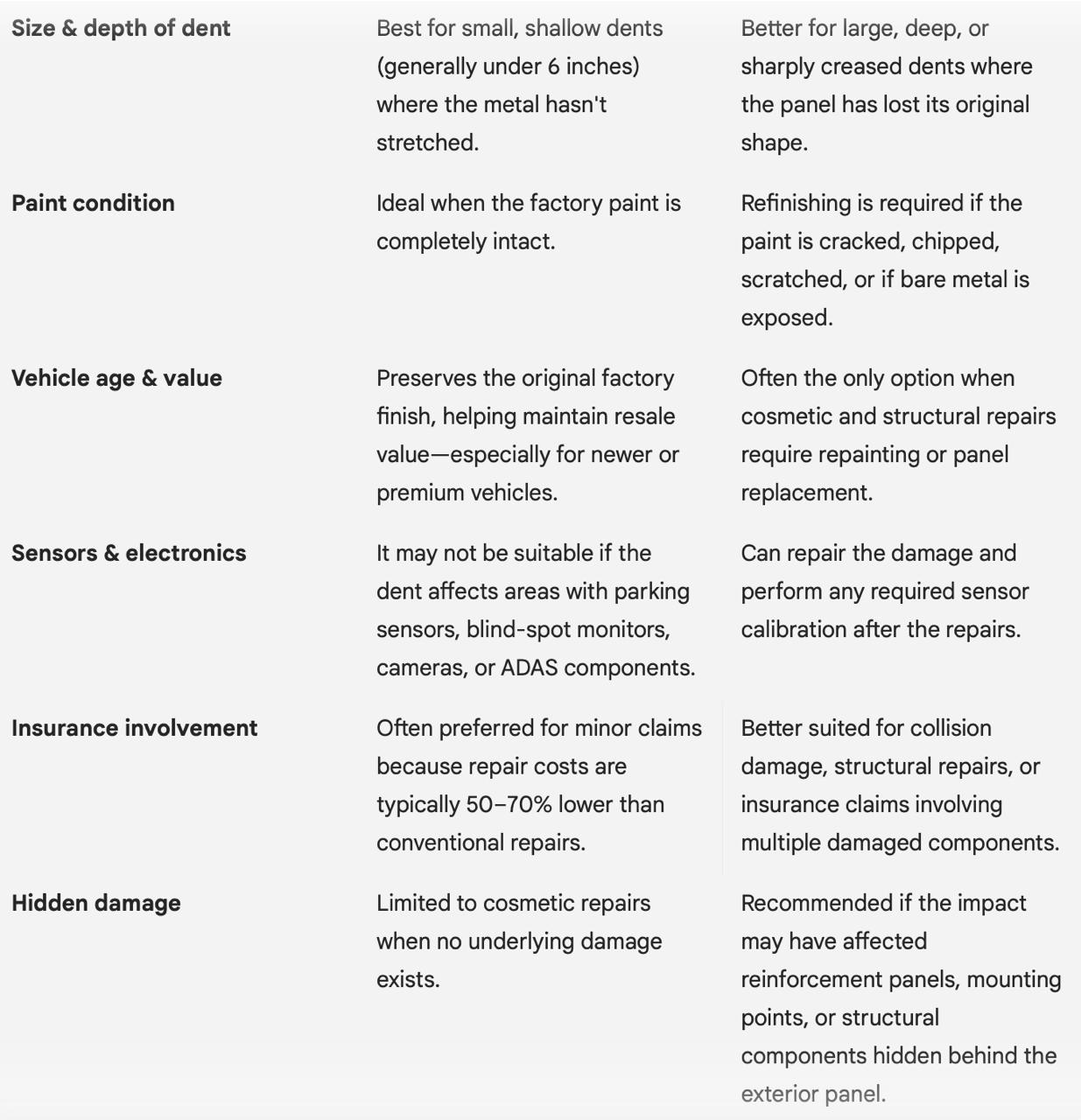
The typical key difference between mobile Paintless Dent Repair (PDR) and body shops depends on the severity of the damage. While mobile paintless dent repair is more affordable and works for minor dents, body shop repair is pricier and works for major dents.
%20vs.%20Traditional%20Body%20Shop.jpg)
80–90% of minor dent damage qualifies for paintless dent repair, making it the preferred solution for most dent damage, provided the paint is intact.
Not always. Mobile dent repair is often less expensive than traditional repair. However, the cost of the cheapest repair depends on the severity of the cosmetic damage.
Here is how to identify them: deep dents, sharp creases, cracked paint, structural deformity, or damage near ADAS sensors. These often require conventional body repair. In this situation, mobile dent repair can not provide a sustainable solution.
Hidden damage can increase the final repair cost. A dent may appear minor at the surface level but reveal hidden damage upon inspection by a trained technician. Such damage often involves ADAS recalibration, especially if it occurs around the bumper area. Additional repair means additional cost.
Traditional collision repair facilities typically perform comprehensive dent repair using specialized paint booths and standard repair procedures, with a warranty. This justifies the higher upfront repair cost for collision-related paint damage.
When you discover a dent on your vehicle, you can quickly tell whether it qualifies for a traditional body shop or mobile Paintless Dent Repair by understanding the types of damage, not just convenience or price.
A professional inspection is often the safest way to proceed, helping avoid unnecessary repairs or missed structural issues.
Always get a professional inspection first. More often than not, dent damage looks minor, small, and uncomplicated until inspected. To avoid guesswork and potential future rework, you need to get a professional inspection as soon as you discover a dent on your car.
Mobile dent repair and mobile paintless dent repair are better and cheaper options if the dent is only cosmetic; however, they are not suitable for all types of damage, especially in complex modern vehicles with advanced materials and safety systems.
Choosing the right repair options helps you protect your vehicle's value and appearance. You can also get a free inspection from Regal Repair if your vehicle has gotten a dent.
Mobile dent repair is an auto repair service in which trained technicians come to your home, office, or other location to repair a dent in your vehicle. It’s one of the most convenient auto repair services.
Yes. A dent repair must qualify for mobile PDR before it’s been fixed with the method. All necessary equipment for repair is transported to the location. So, yes, it’s just as effective as body shop repair.
No. Mobile dent repair can only fix small, minor cosmetic dent damage. Severe dents require body shop use of traditional dent repair methods.
No. Mobile dent repair doesn’t affect resale value because it restores the vehicle's panel to its manufacturer’s condition, leaving no trace of repair. It’s the most effective dent repair solution without diminishing value.
Go to the body shop when the dent damage on your vehicle affects the paint, involves multiple panels, or goes deep into the vehicle's metal.
Get your car repaired at Regal Repair
OEM-certified collision repair and auto body work at two Los Angeles shops: our North Hollywood auto body shop at 5430 Cahuenga Blvd, (818) 505-1442, and our Venice auto body shop at 2101 Lincoln Blvd, (424) 645-0005. See all collision repair services in Los Angeles or get a free estimate.
Save even more at Regal Repair for all your collision repair needs. Take advantage of our special collision repair coupons and deals to get your vehicle back in shape without overspending. Whether it's a minor dent or major damage, our offers provide affordable, high-quality repair solutions. Don't miss out on these limited-time discounts — explore our deals today and ensure your car receives the best care at the best price! Please mention the website coupon at the time of the vehicle estimate.


.webp)
.png)
.webp)
.avif)
.svg)