

.svg)

Primary location
North Hollywood, LA
-
5430 Cahuenga Blvd,
North Hollywood, CA 91601 - (818) 505-1442
Many Kia owners don't understand what "Kia Certified Repair" means—and that can lead to costly mistakes. It is like taking a toothache to a neurosurgeon—the wrong expert for the job.
Understanding Kia-certified repair removes confusion and helps you make confident decisions that protect your vehicle's safety, performance, and long-term value. As a Kia owner, you're probably curious and have questions: What's Kia-certified repair? How does it work? Is it worth it?
This blog post is curated to give you every single detail you need on KIA-certified repair. No fluff, data-backed insights to help you make the right choice for your Kia. Let's dive in.
KIA Certified Repair is a concierge-tailored repair service for KIA vehicles only. This repair follows strict KIA specifications and quality standards to ensure the vehicle's safety and longevity. To ensure KIA cars aren't compromised during repair, here are the boxes that must be ticked:
Pre-repair and post-repair scanning must be done. On top of that, a post-repair calibration for safety systems is mandatory.
So, KIA repair is highly unique and intricate. Therefore, all protocols must be duly observed for a certified and successful repair.
KIA Certified Repair comes with many obvious benefits. While that's true, here's a breakdown of some key benefits you need to know.
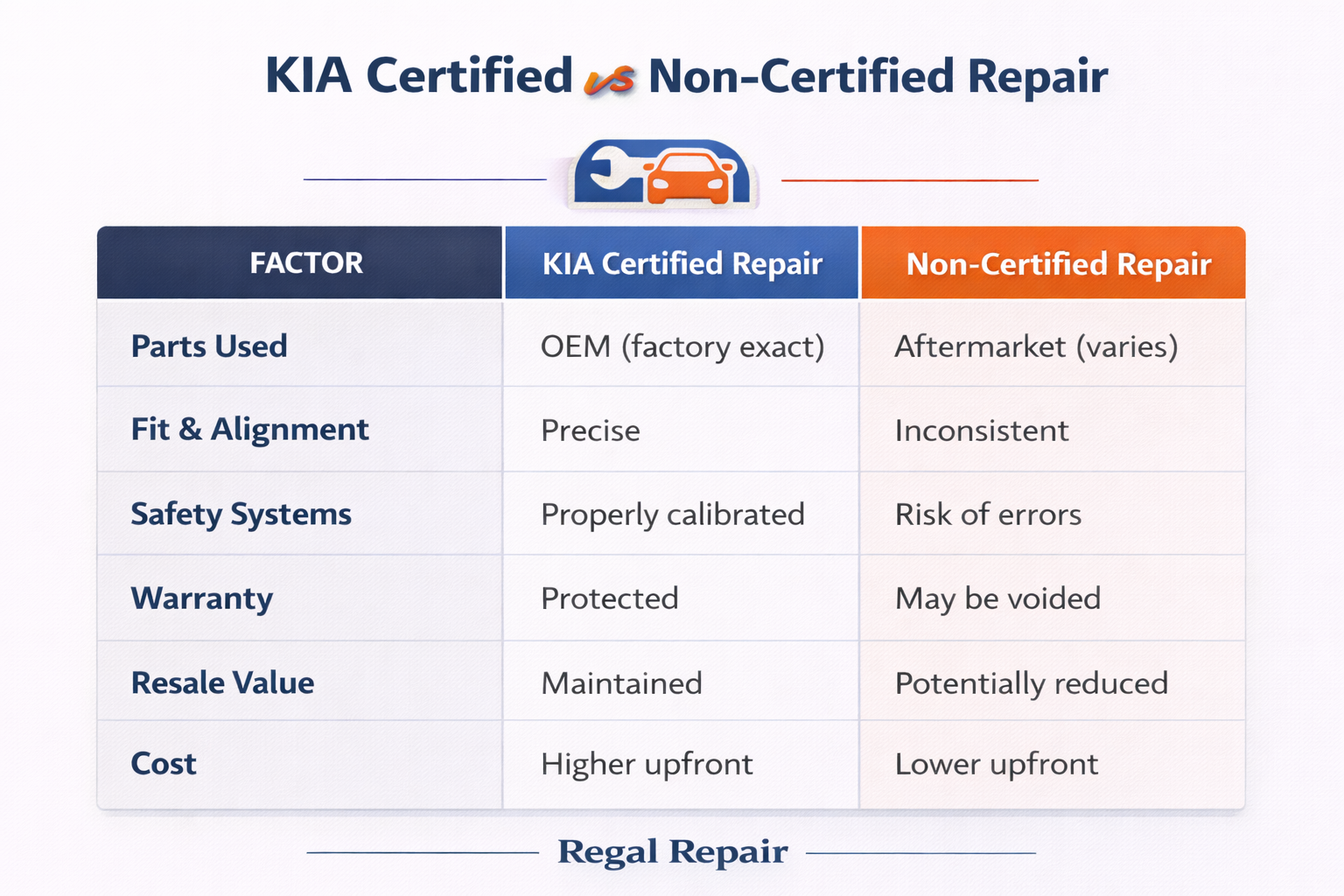
According to the National Association of Mutual Insurance Companies, aftermarket parts are up to 50% cheaper than genuine OEM parts. Choosing an aftermarket part violates Kia-certified repair standards due to its poor-quality surfaces. And the vehicle's value will be reduced.
KIA Certified Repair only accepts OEM parts to maintain factory standards.
KIA OEM parts are built to exact manufacturer's standards to fit and align perfectly. No unfit panel or misaligned part—structural integrity preserved.
KIA is a modern-day innovator with high-end safety systems, including lane-keeping assist, collision warning, a 360-degree monitor, emergency braking, and more. Certified KIA repair ensures these ADAS (advanced driver assistance systems) are properly calibrated. This means safety assurance and disappointment down the road.
Vehicle owners try to cut corners to save money, so they allow uncertified repair shops to fix their vehicles with non-OEM parts. On the other hand, the consequences are huge - this can void part of the manufacturer's warranty if it leads to long-term failure.
OEM-STANDARD repair and parts maintain the KIA value and restore it to "like-new" condition.
KIA Certified Repair aligns with the original manufacturer's standards and procedures to ensure optimal results.
The KIA Certified Repair process moves sequentially. Here's the flow:
KIA repair starts with selecting the right shop—a KIA-certified repair shop. Most shops are under-equipped. A KIA-certified facility that meets specific standards in tools, training, and procedures.
Non-KIA-certified shops cannot perform advanced diagnostic repairs, including complete diagnostic scanning, calibrations, and system resets to restore safety systems.
A KIA-certified repair shop assesses and inspects damage from different angles, including electronics, the frame, and sensors. Assessment goes beyond the surface level.
After a thorough assessment and inspection, a repair plan that strictly follows factory procedures will be drafted.
The repair stage follows precise, manufacturer-approved tools and procedures.
A factory-like paint color matching (if applicable)
This is the part where sensors and safety systems are reset and installed.
This is the post-repair test that ensures car systems and components function as designed: Repair quality is tested in diverse ways, including road tests, visual and body inspections, and post-repair scanning.
The certified KIA repair process ensures compliance with factory warranty requirements, preserves resale value, and restores performance to factory standard. The KIA repair process comes with a warranty.
In situations of KIA-certified repairs, insurance companies are more focused on cost control than on manufacturer specs and repair standards. Most insurance companies typically choose aftermarket parts because they're 10–60% cheaper than OEM parts. While the truth of the matter remains that aftermarket parts are unreliable, unfit, and often low-quality—a 75% inconsistency risk in quality.
An insurance network (DRP) is another underlying factor.
Insurance networks prioritize speed over precision: faster approval, pre-negotiated pricing, and streamlined workflow. However, there's often pressure to reduce repair costs and limited flexibility in repairs.
KIA Certified Repairs are performed with high-quality parts (OEM) to retain the vehicle's original manufacturer's standard in performance, quality, and long-term value.
Use KIA Certified Repair for your vehicle because most Kias have integrated safety systems and often require driver assistance systems. Certified repair ensures the exact repair of the manufacturer's critical safety components and calibration of sensors. Safety components include airbags, structural parts, and sensors.
OEM parts are designed to fit and align properly, reducing installation errors and misalignment risks.
To preserve your vehicle's resale value, OEM-STANDARD repair procedures are highly required.
Using aftermarket parts and non-approved repair centers can void part of your KIA warranty if failure is linked to such sources.
To avoid improper repairs, which are 40% more likely to underperform in a crash, you need to be highly strategic in your approach (IIHS).
You can find KIA Certified repair in two ways: Online and offline. Offline, you navigate using word of mouth. Let's explore how to find a Kia-certified shop online.
Searching for a Kia-certified repair shop is about the biggest work.
And it's not as daunting and complicated as most people think.
Don't rush into picking any yet.
Your checklist:
Do they offer safety systems and sensor calibration?
Are they a KIA repair-certified center?
Do they use OEM parts for repairs?
Do they over-warranty on repairs?
Do they have recent customer reviews and real-time ratings (at least 4.5 stars)?
You need to put these into perspective before you entrust your vehicle to the wrong repair center. Avoid wasted time, low-quality repairs, and compromised resale value.
To avoid improper repair, which is 40% (IIHS) more likely to underperform in a crash, you need to be highly strategic in your approach.
The right insight about certified KIA repair puts you on the right path to make absolutely practical decisions that ensure your KIA's safety, performance, and longevity. This process means little to no risk, a sound financial decision, and a stress-free KIA repair experience.
P.S. This is your chance if you're looking for a certified KIA repair shop—Regal Repair is currently serving Los Angeles and North Hollywood. Contact us here.
What makes a repair center KIA-certified is having I-CAR Gold Class certification, KIA repair certification, trained technicians in KIA-specific repairs, and total adherence to KIA repair procedures during repairs.
Yes. Insurance will cover repairs at a Kia-certified center upon receipt of a repair estimate, in accordance with the insurance policy and contract.
Genuine KIA parts aren't always used, especially in non-Kia-certified repair centers.
Minor repairs are completed within 24 hours, but severe damage takes weeks to fix.
Yes. If you get a repair service from a non-KIA-certified center and it turns out to be a failure linked to that decision, it can void parts of your warranty.
Save even more at Regal Repair for all your collision repair needs. Take advantage of our special collision repair coupons and deals to get your vehicle back in shape without overspending. Whether it's a minor dent or major damage, our offers provide affordable, high-quality repair solutions. Don't miss out on these limited-time discounts — explore our deals today and ensure your car receives the best care at the best price! Please mention the website coupon at the time of the vehicle estimate.


.webp)
.png)
.webp)
.avif)
.webp)