Whether you’re a prospective buyer, a dealer, or an insurer, there’s often some feeling of anxiety and fear. What if you’re purchasing an illegally smuggled car? Or a vehicle that looks good on the outside but is severely depreciating due to existing structural damage?
All your concerns are valid. And you don’t need to worry because there are several ways to uncover previous accident records before you buy.
This guide breaks down how to investigate a vehicle’s past to avoid costly surprises.
Why Accident History Matters
An accident history matters a lot. It is more than a record of past damage. Accident history affects safety, resale value, long-term reliability, and future repair costs. Here is a quick breakdown.
Safety depends on repair quality: A properly repaired vehicle can be completely safe to drive. But a poorly repaired vehicle poses high risks due to hidden structural damage, misaligned crumple zones, or improperly calibrated ADAS (Advanced Driver Assistance System), which can reduce crash protection in future collisions.
Accident History: Lower Resale Value: CARFAX data shows that vehicles with damaged history sell for less on average. Retail value can drop by about $500 and up to $1,700 in severe damage situations.
A previous collision can increase future repair costs: Poor-quality repaired vehicles may experience premature tire wear, water leaks, electrical faults, paint defects, and weak structural components, leading to additional repair expenses for the buyer a few months after purchase.
Vehicle history influences buying and trade-in decisions: CARFAX estimates that approximately 40% of vehicles in the U.S. have sustained damage. And 1 in 4 vehicles currently on sale has a reported history of damage. So, investigating a vehicle's history is important for your bargaining and negotiation decisions before buying a used car.
Start with a Vehicle History Report
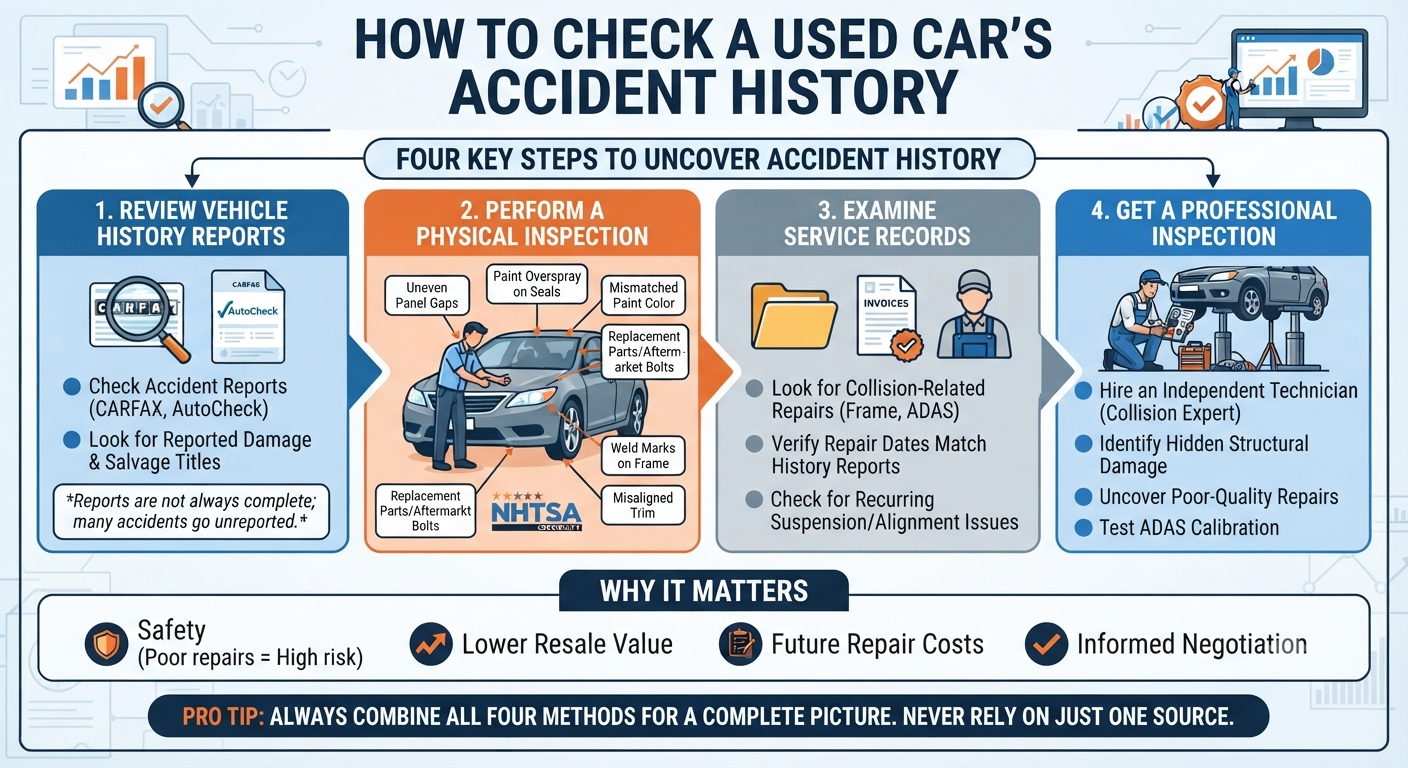
The vehicle history report is the best place to start when investigating a used car accident history. Here’s how to do it:
CARFAX and AutoCheck: Services compile data from thousands of sources, including state DMVs, insurance companies, repair facilities, police reports, salvage auctions, and emissions inspections. CARFAX and AutoCheck reveal reported accidents and car history for those who need them.
Vehicle History Reports are Not Complete: This information is very essential because not all crashes are reported. In fact, CARFAX noted this. Some vehicle repairs are paid for out of pocket, or some of the work performed by shops isn’t shared, and it will never appear on CARFAX and AutoCheck databases. The vehicle looking clean doesn’t guarantee it hasn’t been damaged.
Always combine the report with a physical inspection. Go beyond the public vehicle history database and get an independent repurchase inspection by a qualified collision repair technician to help identify hidden frame damage, poor-quality repairs, paintwork, rust, or ADAS calibration issues that are not visually noticeable.
Inspect the Vehicle for Signs of Previous Repairs
A careful visual inspection to determine whether the vehicle has undergone prior collision repair will reveal the truth.
While many vehicles may receive high-standard, near-perfect repairs, poor-quality repairs may affect safety, resale value, and long-term reliability. The good news is you can easily identify them with the following metrics:
Uneven panel gaps: When you check and find some inconsistent, wider, and narrower gaps between the fender, hood, doors, and trunk, right there is a vehicle that has a collision repair history. Factory-built vehicles have consistent gaps between the body components. The U.S. National Highway Traffic Safety Administration (NHTSA) recommends inspecting body alignment when evaluating a used vehicle after a crash.
Poor color differences: A slight variation in gloss, texture, metallic flake, or shade between adjacent panels often means a repainting. Even with advanced color-matching technology, paint application techniques can create subtle differences.
Overspray: You can tell, especially in a situation where the vehicle gets a low-quality repainting job; you will see obvious paint residues on the vehicle’s rubber seals, trims, wheel wells, headlights, or windows as a common sign of refinishing.
Replacement parts: How to know the vehicle is to check for mismatched fasteners, missing manufacturer labels, and aftermarket components. Such signs can quickly indicate the parts were replaced following a collision.
Weld marks: This is an obvious sign. Spotting fresh, uneven welds, grinding marks, or inconsistent seam sealer inside the engine bay, trunk, or door jambs indicates structural repair.
Misaligned trim: Loose, uneven, or improperly fitted moldings, bumpers, headlights, taillights, or weatherstripping more often indicates a body panel was removed and reinstalled.
Check Service and Repair Records
A vehicle service record is effective at revealing post-collision damage that isn’t obvious during a physical inspection. You can find repair invoices, insurance records, and maintenance documentation and clues about major bodywork.
Look for collision-related repairs: Records monitoring frame strengthening, ADAS sensor calibration, panel replacement, and suspension repairs, among others, are strong indicators the vehicle was involved in a crash.
Compare repair dates with vehicle history reports: To verify whether the reported damage was properly repaired, match repair invoices to the accident dates listed in vehicle history reports from CARFAX or AutoCheck.
Check for recurring repairs: Multiple alignments, suspension replacements, tire wear corrections, or water leak repairs repeatedly can indicate unresolved damage from a previous collision.
Verify replacement parts: Invoices showing OEM parts, paint materials, and repair procedures generally indicate higher repair standards than a missing record or an undocumented repair.
Have a Professional Inspection Performed
Hiring a professional to inspect a vehicle is one of the best ways to spot its collision damage history. You get a higher ROI from a professional inspection than from doing the job yourself.
Here’s the overall view:
History reports have limitations: CARFAX states that not every crash, repair, or maintenance incident is reported. Neither CARFAX nor AutoCheck records every collision repair event in their database. Professional inspection can easily help you identify evidence of unreported repairs, repainting, frame damage, flood damage, and excessive wear and tear.
Inspectors look beyond the paperwork: A vehicle that looks sleek and clean doesn’t mean it has no history of previous collision repair. Quality inspectors check the structural integrity, suspension, brakes, tires, steering, engine, and transmission and use visual and electronic diagnostics to detect complex, hidden damage or faults. AAA recommends a pre-purchase inspection for buyers to uncover often-missed safety problems.
Independent inspections reduce financial risks: According to Consumer Reports, spending $100–$250 on a pre-purchase inspection can help a buyer avoid thousands of dollars in repair costs after purchase.
Body repair experts can spot previous collision work: Experts know better, and this is just the truth. They can swiftly spot uneven panel gaps, mismatched paint, overspray, weld marks, aftermarket parts, and improper repairs that often indicate prior accident damage—even when the vehicle history report shows no reported collision.
What to Ask the Seller
These are the questions you need to ask and answer before considering buying a used vehicle. These answers can help you identify hidden damage that may not be obvious during an inspection, especially if you’re not using a professional inspector.
Has the vehicle been involved in an accident? Even minor collisions can affect critical structural components, suspension, or even Advanced Driver Assistance Systems (ADAS).
Were any insurance claims filed? Insurance records help understand the severity of damage and if the vehicle was properly repaired.
Who performed the repairs? This question further examines whether the repair was performed by a certified, reliable collision facility or by DIY repairs. Ask if OEM repair procedures and manufacturer-approved parts were used.
Was any part replaced or repainted? Know what body panels were replaced and what frame was repainted, and you can tell if the vehicle has been involved in previous collision damage.
Were ADAS sensors recalibrated after repairs? Many modern cars are equipped with safety systems such as lane-keeping, blind-spot monitoring, and adaptive cruise control and often require ADAS recalibration even after minor collisions. Skipping this step can affect the safety system’s performance. Also ask for recalibration repair records.
Can I see maintenance and repair records? Service receipts help you spot a vehicle's repair history and identify recurring issues.
May I have the vehicle inspected by an independent mechanic or collision repair shop? The seller should be able to grant this request to help you clear off all doubt and understand the condition of the used vehicle you’re purchasing after an independent vehicle inspector's results.
Conclusion
Vehicle history reports on the internet (CARFAX and AutoCheck) and the repair facility records are invaluable resources, but they should never be your only source of information. The combination of physical and online records, plus a professional inspection, gives you confidence when making a purchase.
FAQ
Is Carfax always accurate?
No. And they always acknowledge their data limitations.
Can a repaired accident vehicle still be safe?
Yes. After a collision damage repair and post-repair inspection confirmation, the vehicle becomes completely roadworthy.
What accident damage should I avoid?
Primarily, avoid every type of accident damage as much as possible, especially structural damage.
How much does a pre-purchase inspection cost?
A pre-purchase inspection typically costs about $150–$250.
Should I buy a car with an accident history?
The answer depends on your preferences, budget, and how you’ll use the car.
Save even more at Regal Repair for all your collision repair needs. Take advantage of our special collision repair coupons and deals to get your vehicle back in shape without overspending. Whether it's a minor dent or major damage, our offers provide affordable, high-quality repair solutions. Don't miss out on these limited-time discounts — explore our deals today and ensure your car receives the best care at the best price! Please mention the website coupon at the time of the vehicle estimate.
Repair Your Vehicle At Regal And Get:
$500
Repair Your Vehicle At Regal And Get:
Min. $2,000 repair job. Coupon may not used toward any other special services.
Before Returning Your Leased Car To The Dealer, Get:
FREE
Lease Return Repair Inspection
Can be combined
Make It Easy With A:
FREE
Car Loaner or Rental
Up to $40 or rental car cost, with min. repair cost of $2000.
Not valid with other services or promotions. For contact info only. Additional exclusions may apply. Offers not for merchant purposes at time of estimate. Must have printouts.




.svg)



.webp)
.png)
.webp)
.avif)
.webp)