
Unlike a cracked windshield or a bald tire, you cannot see your brake rotor, pads, or hydraulic lines unless you take the wheels off. That makes brake wear easy to overlook—and potentially more dangerous when problems go unnoticed.
Whether you drive a Civic, Accord, CR-V, HR-V, Pilot, or Odyssey Honda, neglecting routine brake inspections and maintenance can lead to higher repair costs and serious safety concerns later on.
In this guide, we break down how the system works, Honda-specific service intervals, model notes for the Civic and Accord, warning signs, and habits to extend brake life. Let's dive in.
Honda’s braking system converts pedal pressure into friction to slow the wheels whenever you press the brake pedal.
Electronic systems add another layer: ABS helps prevent wheel lockup. Vehicle Stability Assist (VSA) can apply the brakes to maintain stability and traction as needed. Brake Assist increases braking force during emergency stops.
Honda's Maintenance Minder (a computer system) tracks your driving habits and tells you when your brakes need service. Sub-code 7 means brake fluid replacement. According to Honda manuals, if the system does not call for item 7 within 36 months, you should generally replace the brake fluid every 3 years.
Brake-pad life has no fixed mileage in Honda manuals. But here's a typical range: passenger vehicles usually get 30,000–70,000 miles, while rotors commonly last 50,000–80,000+ miles.
Regular maintenance ultimately helps you determine the status of your brakes.
Measure brake-pad thickness during an inspection rather than judging it by mileage alone.
A continuous metallic squeal or screech when braking often means the pad's mechanical wear indicator is contacting the rotor, and the pads need replacement.
When replacement is needed, replace pads and rotors as an axle pair—both rear sides—for balanced braking.
Brake fluid retains moisture over time. That can lower its boiling point and contribute to corrosion inside the hydraulic braking system.
For Honda Civic brakes, model year matters.
Modern cars use four-wheel disc brakes, meaning the disc applies to all four wheels. A perfect example is the 2022 and 2025 Civic manuals.
The 2016 and newer Civic generation introduced an Electronic Parking Brake, meaning rear brake service requires placing the EPB into the appropriate service or maintenance mode before retracting the rear brake mechanism.
The reason is simple. Rear brake work on these Civics is less straightforward than on older cable-operated systems.
Performance versions like the Civic Si and Type R use advanced performance braking hardware and different pad specifications, so replacement cost and component choices differ from a standard Civic.
If you don't regularly maintain your Honda brakes, you can mistake a squealing sound for a brake failure. Proper maintenance helps you understand your brake's condition and what each sign indicates.
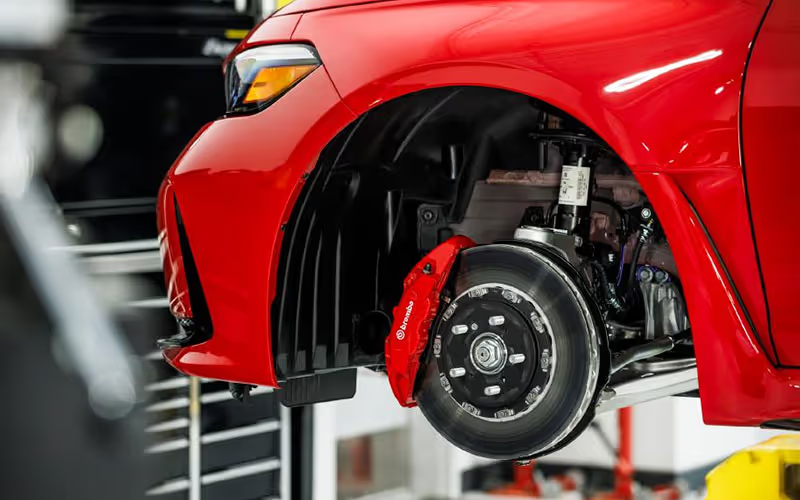
Newer Honda Accord models add electronic controls that affect brake service. Current Accords use an electronic parking brake, while newer versions offer automatic brake hold.
So, if you're doing DIY rear brake work, you will need additional steps compared with older mechanical parking brake systems.
The Accord is also a mid-size sedan, so it's a larger vehicle, which puts substantial demand on the braking system—particularly the front brakes, which handle much of the braking load. However, the pad's lifespan still depends heavily on driving conditions and technique.
Accord Hybrid models operate differently: regenerative braking uses the electric motor to recover energy while the vehicle slows down, reducing demand on the friction brakes.
You step on the brakes and hear a squeaky sound. This indicates the brake pad is worn and contacting the rotor, signaling that the pads are nearing replacement.
A grinding noise means a friction component is worn. If you keep driving, it can damage the rotor.
Pulsing brake pedal or steering-wheel shake often indicates variation in rotor thickness, runout, or uneven braking.
A soft or sinking pedal is another sign. This may indicate air in the hydraulic system, a fluid leak, or a failing master cylinder. It is best not to keep driving in this situation.
Pulling to one side: When you notice your vehicle pulling to one side, it often points to a brake problem.
Dashboard lights and messages are key indicators of brake issues. For example:
If your Honda brake issue falls under a model with an open recall, check it and get it fixed at no cost. Honda recalled 259,033 vehicles in 2025, including 2023-2025 Honda Pilots, because the brake-pedal pivot pin may not have been properly secured.
Honda has a Maintenance Minder (a computer system) that tracks your driving habits and tells you when your brakes need service. Sub-code 7 means brake fluid replacement. According to Honda manuals, if the system does not prompt for item 7 within 36 months, you should generally replace the brake fluid every 3 years.
Brake-pad life has no fixed mileage in Honda manuals.
But here's a typical range: passenger vehicles usually get 30,000–70,000 miles, while rotors commonly last 50,000–80,000+ miles.
Regular maintenance ultimately helps you determine the status of your brakes.
Measure brake-pad thickness during an inspection rather than judging it by mileage alone.
A continuous metallic squeal or screech when braking often means the pads' mechanical wear indicator is contacting the rotor, and the pads need replacement.
When replacement is needed, replace pads and rotors as an axle pair—both rear sides—for balanced braking.
RepairPal’s current national estimate shows that brake-pad replacement alone generally falls between $264 and $399 across these six Honda models; these figures vary by vehicle year and repair location (excluding taxes).
According to RepairPal averages, brake pad replacement costs $342–$399 for the Honda Ridgeline, $319–$379 for the Honda Pilot, $291–$349 for the Honda Accord, $275–$336 for the Honda Odyssey, $271–$328 for the Honda Civic, and $264–$321 for the Honda CR-V.
For example, on an Accord:
Proper brake maintenance includes changing or refilling brake fluid every 3 years, inspecting pads at every Minder service, and never ignoring a soft pedal or a warning message.
After any collision, have brakes and Honda Sensing inspected.
Get a free estimate and free pickup with the North Hollywood and Venice Regal repair shops.
No fixed mileage; inspect pads at every Maintenance Minder service and replace when the wear indicator squeals or pads are near minimum thickness.
Every 3 years regardless of mileage (Minder code 7).
Typically $80–$250
It is a fault in the brake, ABS, or electric parking brake system; get it checked before driving further.
It holds the car at a stop; it switches off if the driver's seat belt is unbuckled, the engine is off, or the system detects a fault.
Hybrid Honda models like the Civic or Accord Pads often last longer thanks to regenerative braking, but fluid still needs changing every 3 years.
Yes: a front or wheel impact can affect brake lines, calipers, ABS sensors, and the Honda Sensing radar.
Regal Repair is an I-CAR Gold Class, OEM-certified auto body shop in Los Angeles offering certified collision repair, free estimates and a lifetime warranty. Visit the shop nearest you: North Hollywood, Van Nuys or Venice & Santa Monica. Get a free estimate or see all service areas.
Get your car repaired at Regal Repair
OEM-certified collision repair and auto body work at two Los Angeles shops: our North Hollywood auto body shop at 5430 Cahuenga Blvd, (818) 505-1442, and our Venice auto body shop at 2101 Lincoln Blvd, (424) 645-0005. See all collision repair services in Los Angeles or get a free estimate.
Save even more at Regal Repair for all your collision repair needs. Take advantage of our special collision repair coupons and deals to get your vehicle back in shape without overspending. Whether it's a minor dent or major damage, our offers provide affordable, high-quality repair solutions. Don't miss out on these limited-time discounts — explore our deals today and ensure your car receives the best care at the best price! Please mention the website coupon at the time of the vehicle estimate.